.svg)
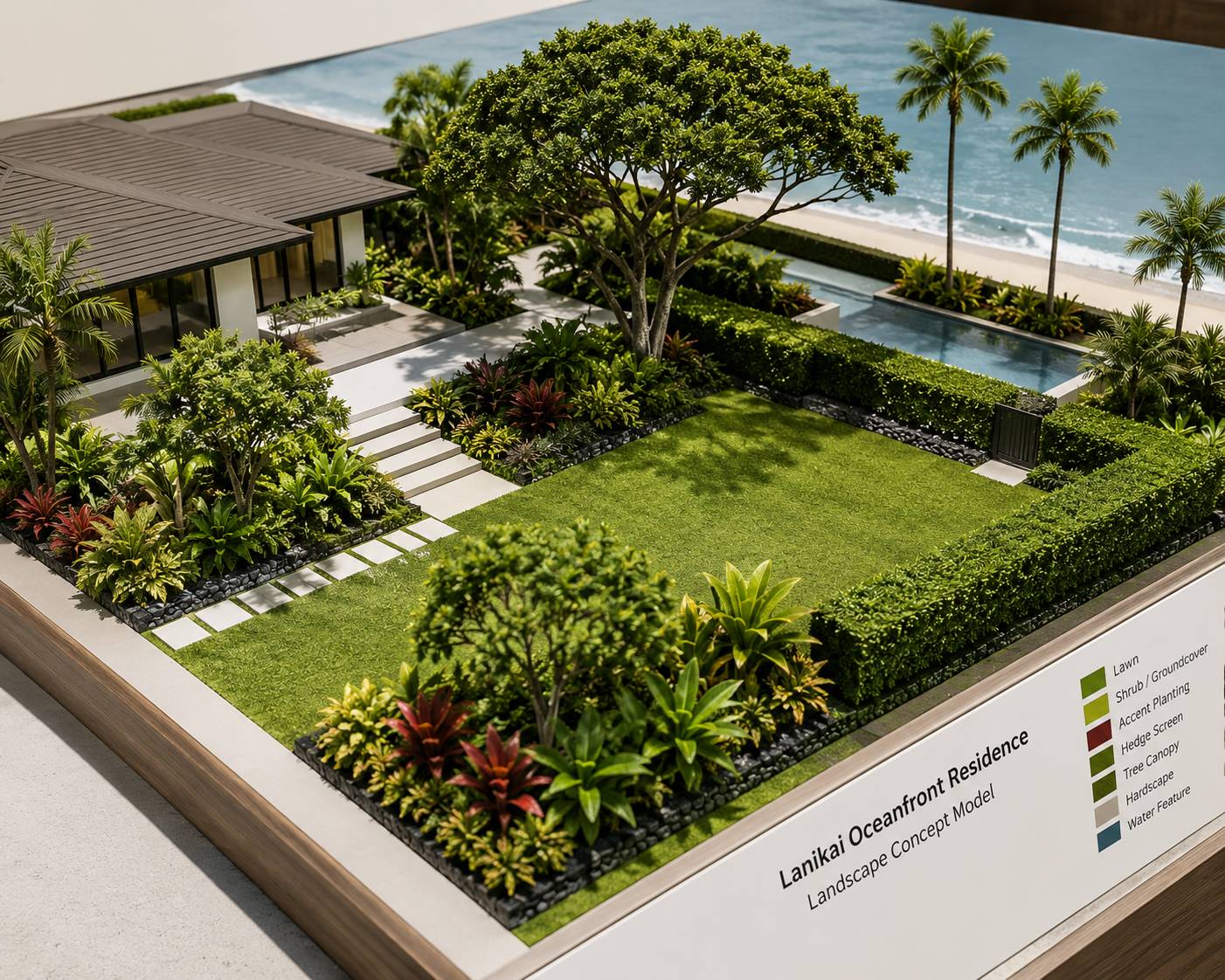
Executing a large-scale commercial development, resort expansion, or municipal infrastructure project on Oahu requires complex logistical precision. In a traditional construction framework, developers and general contractors must manage highly fragmented supply chains where architectural plans, material sourcing, and physical installation are isolated from one another. When it comes to softscaping—the living material that defines a property's final aesthetic and market positioning—this fragmentation introduces massive financial and operational vulnerabilities.
For projects in Hawaii, these vulnerabilities are magnified by geographic isolation. Relying on traditional plant brokers who ship young, unacclimated material across the Pacific frequently leads to project delays, cost overruns, and high plant mortality rates post-installation.
At Pacific Island Landscape LLC, we have eliminated this logistical bottleneck by building our operations around a fully vertically integrated model. By owning and managing our own private landscape nursery in Kapolei, we control the entire lifecycle of our plant material from cultivation to final site installation. This comprehensive guide details why vertical integration is a structural necessity for modern commercial builds and how it directly protects a developer's timeline, budget, and design vision.
The High Risk of Pacific Shipping Delays in Commercial Construction
Commercial general contractors operating in Hawaii understand that the Pacific shipping corridor is unpredictable. Sourcing building materials from the continental United States or international suppliers exposes a project to constant maritime vulnerabilities, including port congestion, shipping container shortages, labor disputes, and extreme weather events. While a delay in receiving structural steel or interior finishes is difficult to manage, a delay in shipping living plant material can be catastrophic.
When a traditional landscape contractor relies on overseas brokers to source trees, palms, and shrubs, those plants spend days packed inside dark, unventilated shipping containers. By the time the container arrives at the port of Honolulu and clears necessary agricultural inspections by the State of Hawaii Department of Agriculture, the living material has often suffered severe transport stress. Plants frequently arrive suffering from root rot, dehydration, foliage drop, or pest infestations.
Attempting to install these compromised assets onto a newly constructed commercial site results in rapid failure. Replacing dead material under warranty forces subcontractors back onto a active job site, disrupting other trades and delaying final certificate of occupancy inspections.
Defining Vertical Integration in Commercial Landscaping
To mitigate maritime supply chain risks, Pacific Island Landscape LLC operates as a vertically integrated contractor. In the context of commercial landscaping, vertical integration means that the same firm responsible for analyzing the landscape architect's blueprints and executing the physical site installation is also the firm that grew, acclimated, and maintained the botanical inventory.
We do not function as a middleman between a developer and a distant plant broker. Instead, our company operates as a self-sustaining ecosystem. We manage our own estimating teams, project managers, heavy machinery operators, and specialized nursery staff.
When a developer awards a commercial landscape installation contract to our team, we immediately secure the required plant palette within our own secure growing grounds. Because the material is already on-island and fully adapted to Oahu’s localized solar and soil conditions, the risk of supply chain disruption drops to zero. This structural capability allows us to offer firm delivery schedules and predictable pricing structures that traditional subcontractors simply cannot match.
The Kapolei Nursery: Engineering an On-Island Inventory Advantage
The operational anchor of our vertically integrated system is our private landscape nursery in Oahu, located strategically in Kapolei. This facility is engineered specifically to meet the high-volume, high-specification demands of large commercial properties, hospitality resorts, and master-planned HOA communities.
Rather than growing small, residential-scale container plants, our nursery specializes in cultivating large-format material, architectural focal points, and dense privacy screening. We maintain a continuous, rigorously monitored inventory of mature canopy trees, structurally established palms, and robust ground covers.
Our specialized nursery team utilizes advanced irrigation infrastructure, custom soil amendments, and proactive pest management protocols to ensure that every asset is in optimal health prior to transit. When our installation crews pull material for a project, the plants undergo a seamless transition from our growing grounds to the job site. There is no shipping shock, no multi-week quarantine period, and no vulnerability to trans-Pacific cargo delays.
Enhancing Landscape Architecture with Immediate Scale
Landscape architects designing for premier commercial developments on Oahu frequently face a major frustration: their design intent is heavily restricted by current market availability. If a blueprint calls for a specific, mature canopy tree line to soften a commercial facade, but the local market only has young saplings available, the property looks bare and unestablished on opening day. It can take five to ten years of intensive maintenance for a young landscape to achieve the scale envisioned in the original architectural renderings.
Our nursery environment completely transforms this dynamic. Because we cultivate large material in-house, we can deliver instant maturity and immediate architectural scale the moment our crews complete the installation. This instant impact is a critical asset for commercial properties that need to attract tenants, open retail spaces, or welcome resort guests immediately upon construction completion.
To understand more about sustainable landscape architecture and the long-term benefits of integrating native flora into commercial developments, developers can reference the sustainable design guidelines maintained by the American Society of Landscape Architects (ASLA).
Streamlining Project Workflows and Developer Accountability
A major hidden cost in commercial construction is administrative friction. Managing multiple subcontractors, verifying chain-of-custody documentation for materials, and resolving disputes over plant warranties consumes vital project management hours. If an installed tree dies on-site, the traditional contractor blames the broker, the broker blames the shipping line, and the developer is caught in the middle of a costly dispute.
Pacific Island Landscape LLC provides a single point of absolute accountability. Because we control the plant from the nursery row to the final irrigation hookup, there is no opportunity for finger-pointing. If an issue arises during installation or during the initial commercial landscape maintenance warranty phase, our internal teams resolve it immediately.
Furthermore, our integrated model streamlines communication between our project managers and the general contractor’s superintendent. We coordinate exact delivery windows, ensuring our trucks arrive on-site precisely when the ground is prepared, eliminating on-site storage needs and reducing traffic congestion on tight construction footprints.
Partner with Oahu’s Vertically Integrated Contractor
For commercial developers, general contractors, and asset managers on Oahu, a successful build requires a partner who understands both the art of horticulture and the realities of construction logistics. Don't let your project's final impression be compromised by an unstable, fragmented supply chain.
Pacific Island Landscape LLC provides the physical infrastructure, the private inventory, and the operational reliability needed to execute flawless commercial rollouts. From initial blueprint review to final site installation and long-term care, our teams deliver uncompromising service across Kapolei, Honolulu, and the entire island of Oahu.
Contact our estimating team today to schedule a private tour of our Kapolei nursery and secure the supply chain for your next commercial project. Request a Landscape Quote.
Frequently Asked Questions: Commercial Landscape Sourcing on Oahu
What are the primary benefits of using a vertically integrated landscape contractor on Oahu? Vertical integration eliminates third-party markups and shipping vulnerabilities. Because the contractor grows their own inventory, developers receive firm delivery timelines, predictable pricing, and exceptionally healthy plant material that has not suffered from the stress of trans-Pacific container shipping.
Can landscape architects visit your nursery to hand-select specific specimens for a project? Yes. We actively encourage landscape architects, general contractors, and developers to schedule private site visits to our Kapolei nursery. Walking our growing grounds allows design teams to personally inspect our inventory, verify scale, and select the exact specimen trees and palms that will be featured on their commercial property.
How does on-island plant sourcing affect commercial landscape warranties? On-island sourcing drastically improves warranty responsiveness. Because we maintain our own inventory, any plant material that fails to meet quality standards during the construction or early maintenance phase can be replaced immediately from our nursery stock, avoiding the multi-week lead times required by traditional brokers.
Does your nursery cultivate native Hawaiian plants for commercial projects seeking LEED certification? Yes. We maintain a steady supply of indigenous Hawaiian plants that are naturally adapted to the island's unique environments. Utilizing these native species helps commercial builds earn points toward LEED certification by reducing long-term irrigation demands and supporting local ecological biodiversity.
How far in advance should a developer contract a landscape team for a large commercial build? For large-scale developments requiring substantial quantities of mature trees, large-format hedges, or rare specimens, we recommend engaging our team 6 to 12 months prior to installation. This extended lead time allows our nursery to custom-cultivate and acclimate your exact plant palette, ensuring total availability when the job site is ready for softscaping.
.svg)