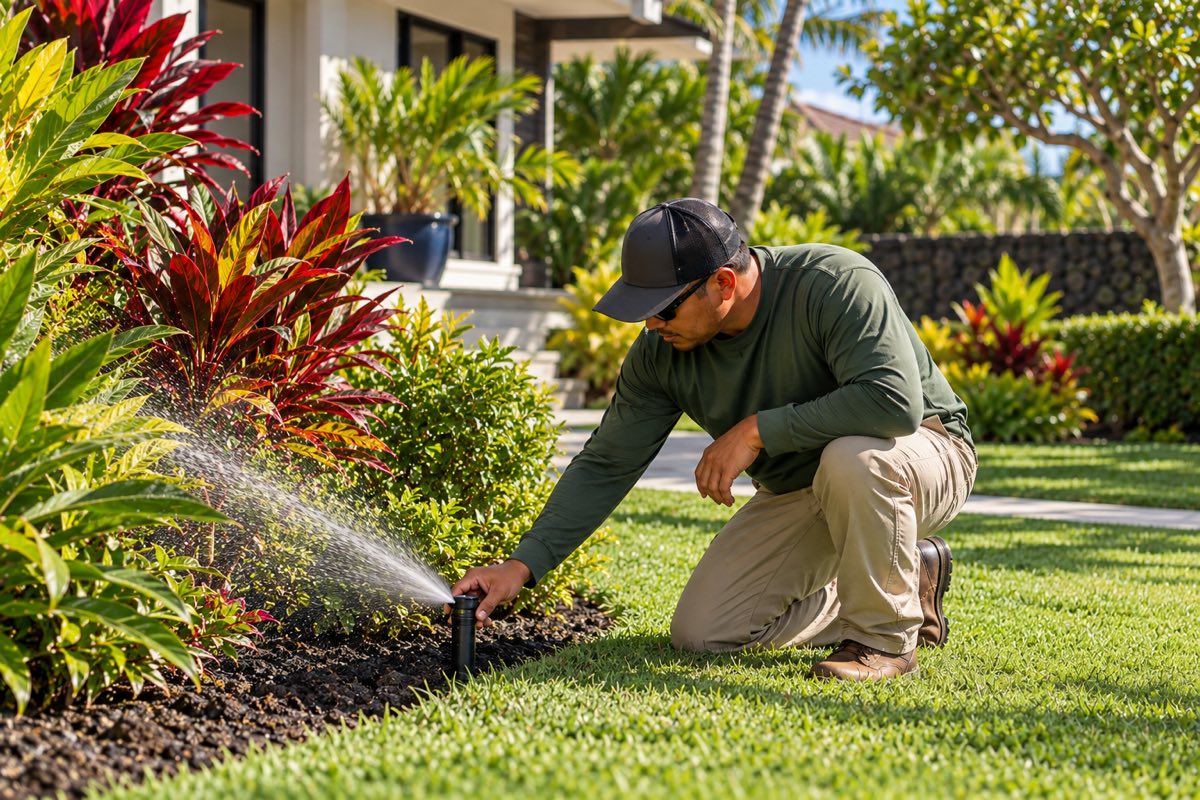
A brown patch in an otherwise healthy lawn might seem like a simple watering problem. But what happens when the sprinkler system is running regularly, the surrounding plants look healthy, and that same area keeps drying out?
The opposite can be just as concerning. A planting bed may remain wet long after irrigation finishes, even while nearby shrubs show signs of stress.
These conditions can indicate an issue with irrigation coverage, watering schedules, drainage, or the system itself.
At Pacific Island Landscape, we include irrigation auditing in our residential estate maintenance programs. We review how existing irrigation systems operate in relation to the landscape's condition and the property's specific needs.
For Oahu homeowners and estate managers, recognizing the warning signs early can help determine whether a routine adjustment or a more detailed evaluation is appropriate.
7 Signs Your Residential Irrigation System Needs Attention
An irrigation system can appear operational while still distributing water unevenly.
Sprinkler heads may activate on schedule, yet certain areas receive too much water while others receive too little.
Watch for these conditions around your property.
1. Dry Patches Despite Regular Watering
A recurring dry patch can indicate insufficient sprinkler coverage, a blocked nozzle, or a problem affecting the irrigation zone.
However, dry-looking grass does not automatically mean more water is needed.
Soil conditions, turf health, and existing root problems can produce similar symptoms.
Before increasing the watering time, check whether the affected area is actually receiving water.
2. Water Collecting Around Planting Beds
Persistent puddles or unusually wet soil may indicate excessive irrigation, poor infiltration, or an existing drainage problem.
If water remains around plant roots, the resulting lack of oxygen can affect plant health.
Increasing irrigation elsewhere on the property will not resolve this condition.
The appropriate response depends on whether the issue comes from watering frequency, system operation, or the surrounding ground conditions.
3. Sprinklers Watering Walkways and Driveways
Water spraying onto hardscape surfaces may indicate a misaligned or unsuitable sprinkler head.
Overspray can waste water and leave walkways wet unnecessarily.
A system inspection can identify whether the affected head needs adjustment or whether the zone requires a different solution.
4. Unexpectedly High Water Use
An increase in water consumption can be a reason to review irrigation operation, particularly if there has been no obvious change in how the property is being maintained.
Possible contributors include extended watering schedules, leaking irrigation components, or a valve that is not functioning properly.
Water use alone cannot identify the cause. A closer inspection is necessary.
5. Plants Showing Signs of Stress
Yellowing foliage, browning leaf edges, and wilting may be associated with inadequate or excessive moisture.
These symptoms can also result from pests, diseases, soil conditions, or environmental exposure.
An irrigation review helps establish whether watering is contributing to the problem.
When symptoms require further investigation, our residential disease control service can evaluate observable plant-health concerns under a separate approved scope.
6. Irrigation Running During or Shortly After Rainfall
Automatic controllers that are not adjusted for changing conditions may continue watering when the landscape does not need additional moisture.
This can be particularly relevant on Oahu, where rainfall and exposure vary by neighborhood and property.
Reviewing the controller settings and actual soil conditions can help determine whether the current schedule is appropriate.
7. Different Planting Areas Receiving the Same Watering Schedule
An established estate may include turf, privacy hedges, mature trees, and ornamental planting beds.
These areas do not necessarily have identical watering requirements.
A single schedule may be unsuitable when planting types, sun exposure, and soil conditions vary significantly across the property.
Why Irrigation Problems Vary Across Oahu Properties
Irrigation requirements depend on more than the type of plants installed.
A property near the coast may experience different wind and salt exposure from a protected garden farther inland. Sloped landscapes can also present different water movement and irrigation coverage concerns.
Even within the same residential estate, a shaded courtyard and a sun-exposed lawn may need different watering approaches.
When evaluating irrigation, we consider the landscape's physical conditions rather than assuming one schedule will suit every planting zone.
Coastal Landscapes
Properties in neighborhoods such as Portlock may experience coastal wind and salt exposure.
These conditions can affect plant performance and should be considered alongside irrigation coverage.
Adding more water is not automatically the answer when plants show stress.
Elevated and Sloped Properties
Properties in areas such as Hawaii Loa Ridge can present wind exposure and changes in grade.
On sloped ground, water may move away from the intended irrigation area before it has adequately infiltrated the soil.
The system's operation should be evaluated alongside existing site conditions.
Established Residential Gardens
Mature plants have different requirements from newly installed landscaping.
As plants grow, their canopies and surrounding conditions can change. Irrigation coverage that was suitable when a garden was installed may no longer match its current layout.
This makes periodic system review useful as the landscape develops.
What Happens During a Residential Irrigation Audit?
An irrigation audit examines whether the existing system is operating appropriately for the landscape it serves.
The exact scope depends on the property and the services requested.
For residential estates, the review may involve several important considerations.
| Inspection Area | What It Helps Identify |
|---|---|
| Sprinkler heads | Misalignment, visible damage, and coverage concerns |
| Irrigation zones | Areas receiving uneven watering |
| Controller settings | Whether schedules reflect current conditions |
| Planting beds | Signs of excessive or insufficient moisture |
| Visible system components | Observable leaks or malfunctioning parts |
| Site conditions | Slopes, shade, and other factors affecting irrigation |
At Pacific Island Landscape, irrigation auditing is included within our residential estate maintenance services.
Our maintenance programs specify regular system inspections and adjustments appropriate to the approved scope.
A review may also reveal problems that require additional work. Significant repairs or improvements should be identified separately before they are authorized.
The purpose of the audit is not to assume that every struggling plant needs more irrigation. It is to establish what the system is doing and whether that operation suits the landscape.
Is Your Landscape Being Overwatered or Underwatered?
Overwatering and underwatering can sometimes produce similar visible symptoms.
For example, wilting does not necessarily indicate dry soil. A plant with roots affected by prolonged saturation may also struggle to take up water.
The following comparisons can help identify conditions worth investigating.
| Possible Underwatering | Possible Overwatering |
|---|---|
| Soil remains unusually dry in the root zone | Soil remains persistently saturated |
| Plants wilt during periods of insufficient moisture | Plants may wilt despite wet soil |
| Turf develops dry areas | Turf or beds may develop persistent wet areas |
| Leaves may become dry or brittle | Foliage may yellow or decline |
| Water may not reach parts of a planting area | Irrigation may run too frequently |
These are observations, not definitive diagnoses.
The University of California's Integrated Pest Management guidance on excess and insufficient water explains how both conditions can affect plant health.
Before changing an irrigation schedule substantially, the actual moisture conditions and system operation should be assessed.
When Is an Adjustment Enough, and When Is a Repair Needed?
Not every irrigation issue requires major work.
Some problems involve the operation of an otherwise functional system. Others indicate damage or limitations that need a separate repair proposal.
Routine adjustments may address:
- Sprinkler heads that require repositioning
- Controller schedules that no longer match current conditions
- Minor coverage concerns that can be corrected within the existing system
Further evaluation or repair may be necessary when:
- Irrigation lines appear to be leaking
- Valves or other components are malfunctioning
- Large sections of the landscape receive insufficient coverage
- Water repeatedly accumulates because of underlying site conditions
- Existing infrastructure cannot serve the current planting arrangement adequately
The distinction matters because irrigation maintenance does not automatically include every potential repair.
Our residential maintenance programs define the included auditing responsibilities. Other irrigation work is documented and approved according to the property's scope.
If the problem involves structural drainage, foundation concerns, or engineered stormwater design, the appropriate qualified professional must address those responsibilities.
How Irrigation Maintenance Supports an Established Landscape
A residential irrigation system should not be treated as a set-and-forget feature.
Plant growth, changing site conditions, and equipment wear can alter its performance over time.
For larger residential estates, ongoing irrigation auditing is particularly useful because planting areas may have different requirements.
Our residential maintenance services include irrigation inspections alongside hedge and plant care, canopy management, and other approved estate maintenance responsibilities.
We provide a dedicated senior account manager for these programs, helping homeowners and estate managers communicate concerns through an established point of contact.
For new construction or significant landscape renovations, irrigation planning can also form part of our residential landscape design process.
The objective is to coordinate watering requirements with the intended planting arrangement rather than treating irrigation as an unrelated feature.
What Should Homeowners Do Before Requesting an Irrigation Assessment?
You do not need to diagnose the problem before speaking with a landscape contractor.
However, a few observations can make the initial discussion more useful.
Take note of where the problem occurs. Is it limited to one planting bed, or does it affect several parts of the property?
Consider when the issue becomes visible. Does water collect during irrigation, after heavy rainfall, or at other times?
If you have irrigation plans or maintenance records, these may help explain the existing system.
Photographs of recurring dry areas, overspray, or pooling water can also provide useful context.
Avoid making extensive changes to controller settings based solely on how the foliage looks. Different causes may require different responses.
Request a Residential Landscape Maintenance Assessment on Oahu
An irrigation problem should be evaluated in the context of the landscape it serves.
At Pacific Island Landscape, we provide estate landscape maintenance across Oahu, including irrigation auditing as part of our property-specific maintenance programs.
Whether you are reviewing an established irrigation system or considering ongoing estate maintenance, we can discuss the visible concerns and determine the appropriate next step.
Visit our residential maintenance assessment form to provide your property details and describe the problems you have noticed.
You can also call 808-347-4462 or email aloha@landscapeoahu.com to discuss your property.
We will review the information and establish the scope needed before proposed work is approved.