Requesting a commercial landscaping quote is straightforward, but getting a proposal that accurately reflects your property's needs takes preparation. Two contractors can assess the same site and recommend different maintenance schedules, services, and project scopes. Without clearly defined requirements, comparing their proposals becomes difficult.
For property managers on Oahu, a landscaping site walk is an opportunity to identify maintenance concerns, explain property expectations, and clarify which areas need attention. It also helps distinguish recurring care from repairs or improvements that may require separate approval.
At Pacific Island Landscape, we review commercial properties before developing property-specific scopes of work. Whether you manage an office building, shopping center, HOA community, or industrial facility, preparing for the assessment helps establish clearer expectations and more informed landscaping decisions.
Why a Commercial Landscaping Site Walk Matters
A property's maintenance requirements are not always obvious from photographs or a general description. Irrigation problems, difficult access points, uneven terrain, mature trees, and areas requiring specialty services can all affect the work being considered.
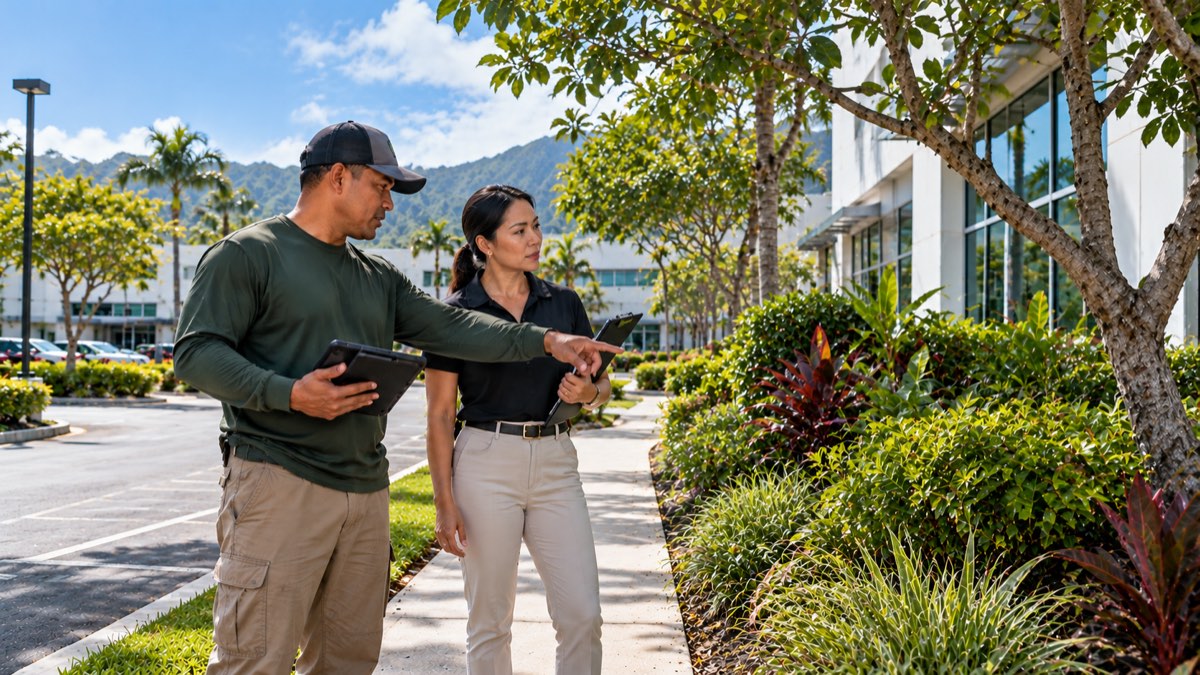
A site walk allows the property manager and contractor to review these conditions together. Instead of estimating services based only on property size, the discussion can address how different landscape areas are used and maintained.
For example, a retail center may need particular attention around customer entrances and pedestrian routes, while an office complex might have several planting zones with different irrigation requirements. An HOA may need maintenance that accounts for shared spaces, community rules, and board-approved budgets.
These differences matter because commercial landscaping proposals should define the services being provided rather than simply present a recurring price. The more clearly the property's requirements are explained during the assessment, the easier it becomes to evaluate the proposed work.
Identify Which Landscape Areas Need Attention
Before meeting with a landscaping contractor, identify the outdoor spaces that should be included in the assessment. This is particularly helpful for larger commercial properties where planting beds, turf, and common areas may be separated by buildings or parking facilities.
Start by reviewing the property's layout and noting the areas requiring routine care. These may include entrance landscaping, hedges, trees, turf, and planting beds near walkways or property boundaries. Also identify spaces maintained by another provider or excluded from the proposed contract.
Not every area needs the same level of attention. Customer-facing entrances may have different maintenance priorities from less visible landscape sections. Similarly, vegetation beside vehicle access routes may require additional consideration because of clearance and operational requirements.
During our commercial landscaping assessments, we review the requested work alongside property access, site conditions, and landscape requirements. This information helps us prepare a written scope that identifies the proposed services and exclusions.
Document Existing Landscaping Problems
One of the most useful ways to prepare for a site walk is to create a short record of landscape concerns. You do not need to diagnose each problem yourself. Observations about recurring issues can help direct attention to areas that need closer review.
You may have noticed thinning turf, declining shrubs, irrigation overspray, excessive weeds, or branches extending into pedestrian areas. Other concerns might include storm debris, damaged planting beds, or palms showing unusual leaf damage.
If a problem occurs intermittently, note when it happens. An irrigation leak may only be visible while the system is running, while an area that stays wet after rainfall may appear normal during dry weather. Photographs can provide useful context when the issue is not visible during the assessment.
It is also important to distinguish ordinary maintenance concerns from potential plant-health problems. Discolored foliage or declining growth can result from irrigation conditions, environmental stress, insects, or disease. Visible symptoms alone do not necessarily confirm their cause.
Our commercial disease control services involve reviewing plant-health concerns and determining an appropriate scope when treatment is warranted. Additional testing, specialist assessment, or plant removal requires separate consideration when applicable.
Review Irrigation Conditions Before the Assessment
Irrigation deserves attention during commercial landscape planning because problems are not always visible until plants begin showing signs of stress. Uneven watering, damaged sprinkler heads, and leaking components can affect landscape conditions and surrounding paved areas.
Before the site walk, gather available information about the irrigation system. Controller locations, known leaks, previous repairs, and areas receiving too much or too little water can help the contractor understand existing concerns.
For properties with multiple irrigation zones, identifying those zones can make the discussion more productive. It also helps clarify whether the requested work involves routine monitoring, minor adjustments, or larger repairs.
Our commercial landscape maintenance services include irrigation auditing, head adjustments, and minor repairs within approved scopes. Larger repairs and mainline replacements are handled separately.
A maintenance agreement should make these distinctions clear. An irrigation inspection does not automatically mean every repair is included, so property managers should review the proposed responsibilities before approving the contract.
Explain Property Access and Operating Requirements
Commercial landscaping needs to account for the activities taking place around the property. Delivery schedules, employee access, pedestrian traffic, and restricted areas may affect how maintenance or installation work should be coordinated.
During the assessment, explain any relevant property rules or operational restrictions. These might include controlled entry points, approved equipment routes, loading areas, or requirements for working near occupied buildings.
For HOA communities, access considerations may involve shared spaces and neighborhood rules. Hotels and retail properties may have additional expectations concerning guest or customer activity.
If your property already has a maintenance agreement, reviewing its access provisions can help identify requirements that should be considered in the new scope. Discussing these details before scheduling reduces uncertainty about where and how the proposed work can take place.
The contractor should also know who is authorized to approve additional work. Identifying the appropriate property contact early helps establish a clearer process when changes or unexpected conditions arise.
Determine Whether You Need Maintenance or Landscape Improvements
Not every landscaping concern can be resolved through recurring maintenance. Some properties need ongoing care for established landscapes, while others require planting improvements, irrigation repairs, or a larger renovation project.
Understanding the distinction helps property managers request services that match their actual needs.
| Property concern | Service to discuss |
|---|---|
| Overgrown hedges and turf | Routine commercial maintenance |
| New planting beds or landscape changes | Design and installation |
| Minor sprinkler adjustments | Irrigation maintenance |
| Major irrigation repairs | Separately scoped repair work |
| Mature tree concerns | Tree assessment or specialty trimming |
| Plant disease or insect concerns | Plant-health evaluation and treatment review |
| Large accumulations of green waste | Separately scoped debris removal |
At Pacific Island Landscape, we provide commercial design, installation, maintenance, and specialty landscaping services. This allows property managers to discuss different landscape needs within one company while keeping each approved scope clearly defined.
For projects involving new planting, material availability may also influence planning. We operate a private landscape nursery in Kapolei, where large-format plant material and specialty specimens may be available for approved projects. Requested species, sizes, and quantities must be confirmed before becoming part of a proposal.
What to Prepare Before Your Landscaping Site Walk
You do not need a complete technical landscape plan to request an assessment. However, gathering a few relevant details can help the contractor understand the property and prepare a more accurate scope.
The following information is useful when available:
- Property plans or landscape drawings: Help identify planting areas, site boundaries, and existing landscape features.
- Current maintenance agreement: Clarifies existing responsibilities and services that may need to continue.
- Known irrigation concerns: Highlights leaks, coverage problems, or components requiring review.
- Access restrictions: Identifies approved entry points, equipment routes, and restricted areas.
- Priority concerns: Shows which landscape problems matter most to property management.
- Approval requirements: Establishes who reviews proposals and authorizes additional services.
It is also helpful to discuss maintenance expectations and known budget considerations. A contractor may need to explain how those requirements affect the proposed work before pricing can be finalized.
For properties managed by boards or multiple stakeholders, identifying the decision-making process early can make subsequent proposal reviews more straightforward.
How to Evaluate the Landscaping Proposal
After the site walk, review the proposal carefully before selecting a contractor. A useful commercial landscaping agreement should explain which areas are included, the services being offered, and the responsibilities associated with the proposed work.
1. Confirm the Scope of Work
Start by checking that the proposal covers all the areas discussed during the assessment. If certain locations require specialized attention or are excluded from the agreement, those details should be clearly documented.
2. Review Maintenance Activities and Visit Frequency
Examine the proposed maintenance services and how often they will be performed. Properties with extensive planting or demanding operational requirements may need different service arrangements from smaller facilities with simpler landscapes.
3. Check Exclusions and Additional Costs
Pay particular attention to services that are excluded or priced separately. Major irrigation repairs, tree removal, plant replacements, and substantial debris removal may fall outside recurring maintenance. Understanding these boundaries helps prevent unexpected costs and confusion when additional work becomes necessary.
4. Understand the Approval Process for Additional Work
Confirm how changes or additional services will be reviewed and authorized. At Pacific Island Landscape, we prepare property-specific written scopes, with field changes requiring authorization before proceeding.
A clear proposal makes it easier to compare contractors based on the actual services offered rather than relying on the total price alone.
Schedule a Commercial Landscaping Assessment on Oahu
A well-prepared site walk creates a clearer starting point for maintaining or improving your commercial property. It allows landscaping concerns to be reviewed alongside access requirements, existing site conditions, and the services you want included.
We work with commercial properties across Oahu, including office facilities, retail centers, industrial properties, and managed communities. Our process begins with understanding the property and requested work before preparing a written scope with proposed services, exclusions, and pricing.
Ready to discuss your property's landscaping needs? Contact Pacific Island Landscape to request a quote. Tell us about your property and the services you're considering, and we'll help you determine the next steps.
Call 808-347-4462 or email aloha@landscapeoahu.com to get started.
Pacific Island Landscape | Kapolei, Oahu | License CT-35972