.svg)
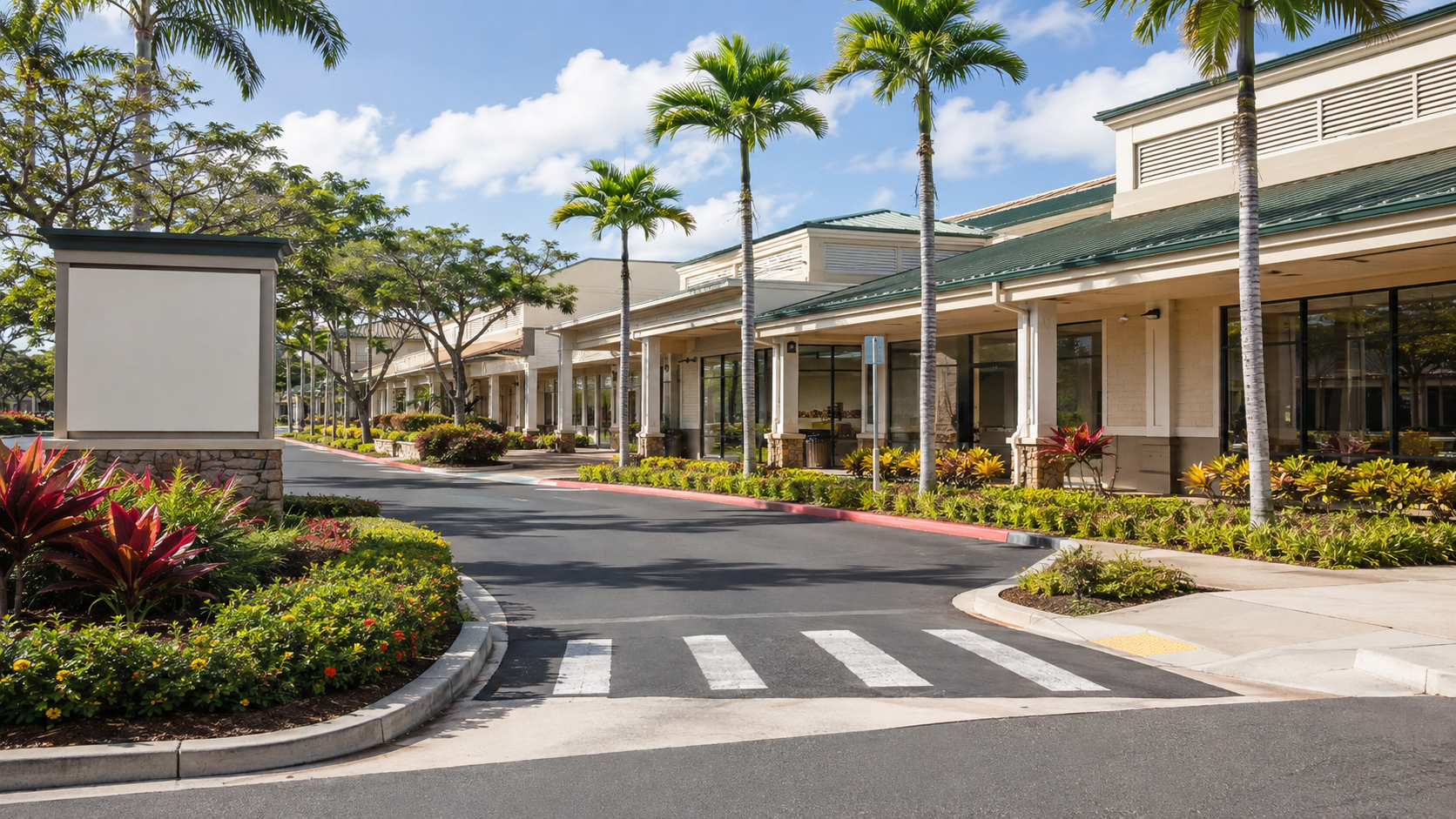
At Pacific Island Landscape LLC, we maintain outdoor spaces for Oahu commercial properties, including shopping centers. In a retail environment, landscape maintenance affects more than the appearance of planting beds. Branches can move into a tenant sign’s viewing area. Shrubs may narrow a walkway or cover a directional marker. Overgrown groundcover can soften the visible edge between a parking island and an active drive aisle.
Retail landscape maintenance should preserve a clear relationship between the landscape and the built environment. The goal is not to remove every plant near a sign or storefront. It is to manage growth so the property remains legible to shoppers while protecting the intended landscape design. A documented sightline plan gives retail asset managers a consistent standard for approving work across the center.
Define the Visibility Envelope Before Pruning
A general instruction to “open the sightline” is difficult to price and difficult to verify. The property team should identify the viewing position and the feature that needs to remain visible. A monument sign viewed from an entry drive has a different visibility envelope from a tenant panel read by pedestrians. A storefront window also needs a different standard from a stop sign on a site roadway.
Walk the center from the places where decisions are made. Review vehicle approaches at a safe location. Check pedestrian routes from parking areas to storefronts. Photograph each target from the intended viewing position, then mark the vegetation affecting it. This creates an objective reference for the work order and the follow-up review.
| Retail zone | Visibility target | Maintenance question |
|---|---|---|
| Property entrance | Monument sign or center identification | Does plant growth interrupt the primary message area? |
| Internal drive aisle | Directional or traffic-control sign | Is the sign visible from the intended approach? |
| Storefront frontage | Tenant sign and display window | Does the landscape frame the storefront without covering it? |
| Pedestrian route | Curb edge and crossing point | Has vegetation reduced the usable route? |
| Parking island | Vehicle approach and stall boundary | Are branches or groundcover extending into circulation space? |
| Service area | Access gate or loading marker | Can authorized users identify the route? |
Record the visibility envelope by location instead of using a generic height limit. Approved landscape plans may require screening where complete openness is not the design intent.
Shopping Center Landscaping Oahu Properties Need to Coordinate With Access
Landscape growth can reduce the usable width of a route even when the pavement has not changed. Fronds may bend into the walking area. Shrubs can expand beyond a planter edge.
The U.S. Access Board’s guide to accessible routes explains that an accessible route generally requires a continuous clear width of at least 36 inches, with limited exceptions. Site-specific compliance depends on the route and applicable standards. A landscape walkthrough does not certify ADA compliance, but it should flag vegetation that appears to reduce clear space.
Asset managers should also keep curb ramps and detectable warning surfaces free of landscape debris. Plant material should not cover posted accessible parking signs. If roots have lifted pavement or changed the slope, that is no longer a routine trimming issue. The condition should be documented and sent to the party responsible for the walking surface.
Protect Sign Visibility Without Damaging the Landscape
Retail signs function at different distances. A pylon or monument sign is read from a moving vehicle. A tenant blade sign may be read from the sidewalk. Directory panels are often viewed at close range. Maintenance specifications should identify which part of each sign must remain unobstructed and from which direction.
Pruning should begin with a stated objective. The International Society of Arboriculture’s consumer guidance explains that crown raising removes lower branches to provide clearance for buildings or vehicles. It can also improve clearance for pedestrians and views. The same ISA pruning guidance warns that each cut can change future growth.
That means a sightline correction should not become indiscriminate canopy removal. Mature trees or branches with possible structural concerns may require an appropriately qualified tree professional. Work near overhead electrical lines requires separate utility coordination. We do not represent routine landscape maintenance as a formal tree-risk assessment.
Shrub maintenance requires the same clarity. A hedge may be intended to screen parked vehicles while staying below a directory panel. Reducing it too far can defeat the screening purpose. Allowing it to grow without a defined boundary can cover the sign. The approved height should be connected to the site plan and documented viewing angle.
Select Plants for Their Mature Size
Recurring sightline conflicts often begin with plant selection. A shrub that fits below a window at installation may grow beyond the available space. A tree placed close to a tenant panel may require repeated clearance pruning. Roots may also compete with confined planting volume in narrow parking islands.
Before replacement, the property team should review mature height and spread. Root-zone space should be considered separately. Irrigation coverage and available sunlight also affect whether a proposed plant is appropriate. Where visibility must remain open, the design can use lower-growing material rather than relying on frequent reduction.
Our private landscape nursery in Kapolei can reduce reliance on off-island sourcing for suitable plant material. Availability depends on species and size. Quantity and project schedule also require confirmation. We do not promise a specific replacement until inventory and site requirements have been reviewed.
Make Curb Appeal Measurable
Curb appeal is often treated as a subjective judgment. Asset managers can make it more useful by defining observable conditions. Bed edges should follow the approved layout. Mulch or soil should remain out of circulation areas. Dead material should be identified for an approved response. Irrigation should serve the planting area instead of adjacent pavement.
These standards support a consistently managed exterior, but they do not prove an increase in shopper traffic or tenant performance. Clean storefronts remain a separate responsibility unless included in the landscape scope.
| Inspection item | Record as acceptable when | Escalate when |
|---|---|---|
| Tenant sign sightline | Required message area is visible from the documented position | Growth enters the defined visibility envelope |
| Pedestrian clearance | Vegetation remains within the approved planting boundary | Branches or foliage reduce the usable path |
| Parking island edge | Groundcover stays behind the curb line | Material extends into stalls or drive aisles |
| Bed condition | Soil and mulch remain contained | Runoff or maintenance activity moves material onto pavement |
| Irrigation operation | Water remains within the intended planting area | Overspray or visible leakage reaches a customer route |
| Plant condition | The plant matches the approved maintenance response | Decline or disease symptoms require diagnosis |
Coordinate Maintenance With Retail Activity
Work timing affects how a shopping center experiences landscape service. Pruning beside a storefront may require a temporary work zone. Debris removal can conflict with loading activity. Irrigation testing may need to occur before shopper traffic increases.
Each work order should name the location and approved task. It should identify the access window and the party authorized to close an area. If a tenant has a promotion or delivery scheduled, the property manager can adjust timing before the crew arrives. This coordination should be confirmed in writing rather than assumed from the recurring maintenance calendar.

Use Site Documents as the Control Point
Landscape maintenance should not quietly alter an approved design. Keep the current landscape plan and sign plan available when conflicts appear. Lease exhibits may assign responsibility for tenant-controlled frontage. Those documents can determine whether pruning or plant replacement is authorized. A design modification requires separate approval.
Honolulu’s Department of Planning and Permitting maintains the current Land Use Ordinance update, including changes that became effective in 2025. Requirements can vary by property and permit history. Any question about zoning or an approved sign plan should be directed to the appropriate design or permitting professional.
For asset reporting, use dated photographs from the same viewing position. Record the location and observed condition. Attach the approved work order, then photograph the completed area. This creates a repeatable record without treating a landscape review as a safety inspection or code certification.
Discuss Retail Landscape Maintenance With Us
We provide commercial landscaping and maintenance on Oahu for several development types, including shopping centers. Our published services include the installation and maintenance of plants or trees. We also maintain shrubs and tropical flowers. Debris and waste removal is available as a separate listed service.
Contact Pacific Island Landscape LLC for an estimate and tell us which sightlines or retail zones need attention. We will define the requested landscape scope in writing. If the condition requires an outside specialist or utility coordination, that responsibility should be confirmed before work begins.

.svg)