
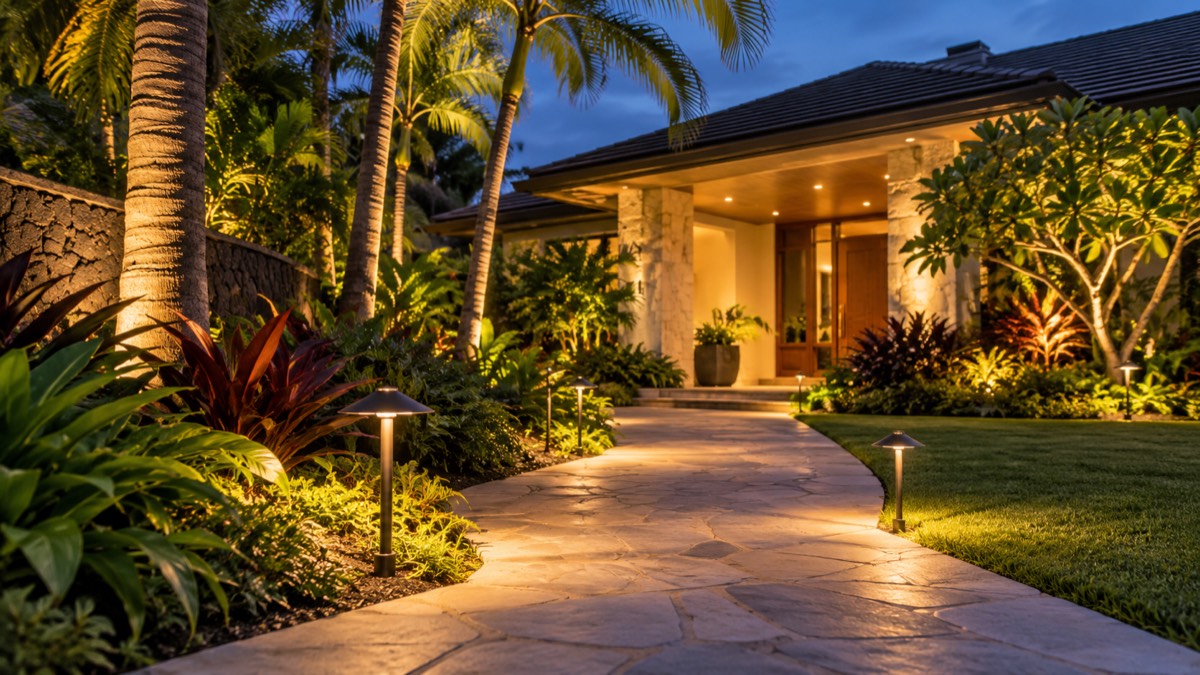
A beautifully maintained landscape can look completely different after sunset. Without thoughtfully placed lighting, pathways become harder to see, planting features disappear into the darkness, and outdoor spaces lose much of their visual character.
If you're searching for a landscape lighting installation near you on Oahu, the first decision isn't which fixtures to buy. It's understanding what you want the lighting to accomplish and how the system will work with your existing landscape.
At Pacific Island Landscape, we provide low voltage landscape lighting for high-end residential estates and commercial properties across Oahu. We plan each installation around the property's layout, existing plants, and intended nighttime use.
Here's what to consider before investing in an outdoor lighting system.
Why Landscape Lighting Requires Special Planning in Hawaii
Outdoor lighting on Oahu faces environmental conditions that can affect equipment selection and long-term performance.
Salt exposure is an important consideration for coastal properties. Moisture and irrigation spray can also affect fixtures and connections, particularly when equipment isn't suited to the installation environment.
Tropical plant growth introduces another challenge. A fixture positioned beside a young shrub may become obstructed as the plant matures. Lights installed too close to planting areas can also interfere with ongoing landscape maintenance.
When planning an installation, we consider several property-specific factors:
- Coastal exposure: Fixture materials and equipment suitability for locations affected by salt spray.
- Rainfall and irrigation: Appropriate placement around areas exposed to moisture.
- Plant growth: Clearance around shrubs, trees, and planting beds.
- Existing infrastructure: Cable routes, irrigation components, hardscapes, and power-source requirements.
- Nearby windows: Light direction and fixture placement to limit unwanted glare.
These considerations help establish an installation plan suited to the actual property rather than relying on a standard lighting kit.
Choosing the Right Landscape Lighting for Your Property
Different outdoor areas benefit from different lighting approaches. The goal is to provide illumination where it's useful without making the landscape unnecessarily bright.
Pathway and Step Lighting
Walkways, garden paths, and changes in elevation are natural starting points for a lighting plan.
Low-level fixtures can illuminate selected walking surfaces and help people identify transitions between outdoor areas.
For residential estates, this may include the approach from the driveway to the front entrance. Commercial properties may prioritize pedestrian routes between buildings, landscaped courtyards, and visitor entrances.
Fixture spacing and beam direction should account for the actual route rather than assuming every pathway needs the same arrangement.
Tree and Palm Uplighting
Directional lighting can highlight the shape of a mature tree or bring attention to a distinctive palm.
However, fixture placement matters. Lighting positioned too close to the trunk may create an overly concentrated effect, while surrounding plants can obstruct the beam.
Before including a tree in the lighting design, we consider its condition, surrounding vegetation, and access for future landscape care.
Our tree trimming and canopy management services can also be coordinated with lighting work when both services are included in the approved scope.
Entryway and Architectural Accent Lighting
Entry lighting can help define how visitors approach a property after dark.
For residential landscapes, this might involve illuminating planting beds near the entrance or highlighting selected architectural features.
On commercial properties, accent lighting may help establish a consistent nighttime presentation around an entrance or courtyard.
The design should also account for nearby windows and adjoining properties so illumination stays focused on the intended features.
Low Voltage vs. Traditional Outdoor Lighting
Low voltage lighting is a practical choice for many landscape applications because it supports targeted illumination through a system designed for the selected fixtures.
The distinction between low voltage and line-voltage lighting is important when reviewing an installation proposal.
| Consideration | Low Voltage Landscape Lighting | Line-Voltage Lighting |
|---|---|---|
| Typical applications | Pathways, planting accents, landscape features | Building-mounted or broader exterior lighting applications |
| Electrical arrangement | Uses compatible low voltage equipment and an appropriate power source | Uses line-voltage electrical circuits |
| Installation scope | Can be coordinated with landscape installation | Requires appropriately qualified electrical professionals |
| Design flexibility | Useful for targeted landscape illumination | Depends on the fixtures and electrical design |
We specialize in low voltage landscape lighting. New line-voltage circuits, electrical panel work, and security-system integration are outside our landscape lighting scope.
Are LED Landscape Lights Worth Considering?
LED lighting is worth evaluating when selecting equipment for a new installation or updating an older compatible system.
According to the U.S. Department of Energy's lighting efficiency guidance, LEDs can use substantially less energy than traditional incandescent lighting.
The draft's reference to approximately 75% lower energy consumption is consistent with DOE guidance. Actual savings depend on the products being compared, system wattage, and operating hours.
Energy efficiency is only one consideration. Fixture quality, lighting direction, compatibility, and exposure to outdoor conditions also influence the equipment selected for the project.
What Affects Landscape Lighting Installation Costs on Oahu?
There isn't a single reliable price for landscape lighting installation because every property requires a different scope.
A small entryway lighting project will have different equipment and installation requirements from a larger estate with multiple garden areas or a commercial property with extensive pedestrian routes.
The main cost factors include:
- Number and type of fixtures. Path lights, accent lights, and directional uplights may require different equipment.
- Property layout. Distance between lighting areas influences cable routing and equipment requirements.
- Existing conditions. Irrigation systems, paved surfaces, mature roots, and restricted access can affect installation work.
- Equipment selection. Materials and product suitability may vary depending on coastal exposure or other site conditions.
- Existing lighting infrastructure. Expanding a system requires reviewing its capacity and compatibility before adding fixtures.
A lower upfront equipment price doesn't necessarily mean the complete installation will cost less over time. However, professional installation also shouldn't be presented as eliminating future repairs or maintenance.
When comparing quotes, ask whether the proposed price includes fixture locations, cable routing, equipment, affected landscape restoration, and any separately assigned electrical work.
We provide property-specific written scopes after reviewing the requested work. You can request a landscape lighting quote to begin that discussion.
What Happens During Our Landscape Lighting Installation Process?
Understanding the installation process helps you prepare your property and evaluate what is included in a proposal.
1. Initial Consultation and Property Review
We begin by discussing the areas you want illuminated and the purpose of the lighting.
During the site review, we consider existing landscape conditions, intended fixture locations, and known infrastructure that may affect the installation.
2. Lighting Layout and Scope Development
We develop the proposed layout around the agreed lighting objectives.
Fixture placement, cable-routing considerations, equipment requirements, and relevant limitations are documented before the work is approved.
For existing lighting systems, we also review available equipment information before determining whether an expansion is appropriate.
3. Installation and Field Review
Once the scope is approved and scheduling is confirmed, installation proceeds according to the agreed work.
Any changes involving fixture placement, materials, or additional site work are reviewed for authorization rather than assumed to be included.
4. Ongoing Landscape Coordination
Landscape lighting may need attention as vegetation grows or the property changes.
Our residential landscape maintenance services include property-specific plant and canopy care. Lighting-related adjustments or maintenance must be included in an approved agreement rather than assumed to be part of a general maintenance contract.
Why Work With a Landscape Contractor for Outdoor Lighting?
Lighting and landscaping are closely connected.
A fixture may look correctly positioned during installation but become ineffective when surrounding plants grow. Cable routes can also conflict with irrigation systems, planting beds, or planned landscape improvements.
Working with a contractor familiar with both landscape installation and maintenance helps these considerations become part of the initial planning conversation.
We provide landscape design, installation, maintenance, and specialty services under one company. That allows us to coordinate low voltage lighting with other approved landscape work when a project requires it.
We also operate a private landscape nursery in Kapolei, which supports the planning and sourcing of selected landscape material for residential and commercial projects. Nursery inventory is confirmed by project.
For a new landscape or major renovation, coordinating lighting before final planting can help reduce conflicts between fixture placement and the finished landscape.
Questions to Ask Before Hiring a Landscape Lighting Installer
Before accepting a proposal, make sure you understand exactly what you're purchasing.
Ask your prospective contractor:
- What areas will the proposed fixtures illuminate?
- Are the selected fixtures appropriate for the property's environmental exposure?
- Does the scope include the necessary low voltage equipment and cable routing?
- Will existing irrigation or hardscape features affect installation?
- Who is responsible for any required line-voltage electrical work?
- What happens if the proposed layout needs changes during installation?
- Are future repairs, fixture adjustments, or maintenance included?
These questions help you compare the full scope of competing proposals rather than focusing only on fixture counts.
For commercial properties, also ask how installation access will be coordinated around occupants and property operations.
Our commercial low voltage lighting service addresses these considerations through property-specific planning and written scopes.
Plan Your Landscape Lighting Installation on Oahu
A well-planned lighting system begins with the property, not a catalog of fixtures.
Whether you're considering pathway lighting for a residential estate, uplighting for mature trees, or improvements to a commercial landscape, the right approach starts with understanding the areas you want illuminated and the conditions surrounding them.
At Pacific Island Landscape, we provide low voltage landscape lighting for residential estates and commercial properties across Oahu, with a focus on practical layouts and clearly defined installation scopes.
Ready to discuss your property?
Request a landscape lighting quote or call 808-347-4462 to tell us about your project.
Pacific Island Landscape | Kapolei, Oahu | Hawaii Contractor License CT-35972